
Hardcore, Hip-Hop and a Saxophone: What Makes Dog Eat Dog Sound Like Dog Eat Dog

The first Dog Eat Dog gig wasn't on a stage at all. It was in Dave Neabore's basement in Bergen County, New Jersey, on 1 April 1990. Five years later the same band was MTV Europe's Breakthrough Artist of 1995 and playing festivals like Dynamo Open Air, Reading and Roskilde.
So what got a basement band from Jersey there? The short answer is a sound that refused to pick one lane. Here is what goes into it, piece by piece, and the designs that suit each part, in case you're looking for something to wear this winter or a gift for the person who still plays All Boro Kings loud.
Where did the band come from?
Dog Eat Dog grew out of Mucky Pup. Neabore and Sean Kilkenny left after that band's last show on 22 April 1990. John Connor, who had roadied for Mucky Pup, stepped up as the singer, and Dan Nastasi joined on guitar. Early shows ran under other names, including "Face Off", "F-Troop", "B-Load" and "Rubber Band", before Dog Eat Dog was proposed and stuck.
Connor and Neabore have been there since the start. Today they are joined by Brandon Finley on drums and Roger Haemmerli on guitar. If you want the longer version of the story, the Dog Eat Dog about page sets it out.
What does "crossover" actually mean here?
Dog Eat Dog is usually filed under rap rock or rap metal, but the band sits on several genres at once. Think of it as four ingredients:
- Hardcore and metal: the heavy guitars and the speed.
- Hip-hop: Connor's rapped vocals and the rhythm of the lines.
- Funk: the bounce underneath, carried by Neabore's bass.
- Saxophone: not something most heavy bands bother with. Scott Mueller played sax with the band from 1995 to 1997, and it became one of the things people remember them for.
That mix is why Dog Eat Dog could open for Biohazard across Europe and still land a single, "No Fronts", at No. 9 in the UK. It's heavy enough for a mosh pit and catchy enough for the radio.
Which records should you start with?
The catalogue is easy to get into because it's compact:
- Warrant (Roadrunner, 1993): the EP that started the recorded story.
- All Boro Kings (Roadrunner, 1994): the first album, released on 24 May 1994, and the record most people mean when they say Dog Eat Dog. It got a 25th anniversary edition on Metalville in 2019.
- Play Games (Roadrunner, 1996): the follow-up from the years the sax was in the lineup.
- Amped (1999), Walk with Me (2006) and the Brand New Breed EP (2017): the long middle stretch.
- Free Radicals (Metalville, 2023): the most recent album, and proof the band is still at it more than three decades on.
The band has marked its own history along the way too. The original lineup played two songs together on 11 December 2009 and shows on 2 and 3 April 2010 for the 20th anniversary.
Which designs match which side of the sound?
The Dog Eat Dog range follows the same idea as the music: hard and funny, street and loud. Black, yellow and white are the core look, so most pieces go with whatever is already in a wardrobe.
For the hardcore side: Work Ethic has outlined varsity letters on the front and two snarling dogs above stacked blackletter "Dog Eat Dog" on the back. Bleach USA puts a snarling dog behind a chain-link fence in black and white. Both are the bite of the band in one graphic.
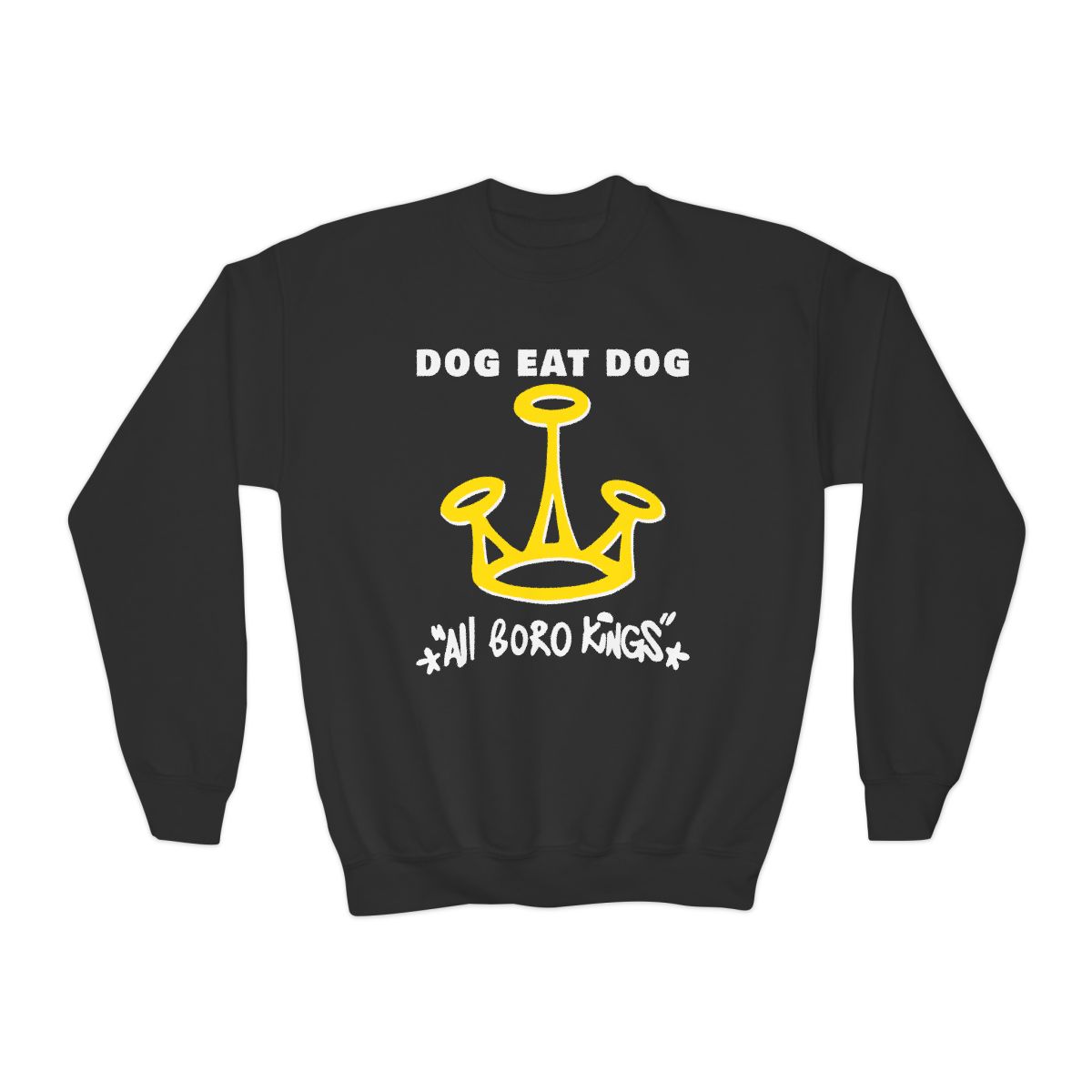
For the hip-hop and street side: All Boro Any City is a small yellow hand-drawn crown on the front, with the crown repeated on the back between "All Boro" and "Any City" in spaced capitals. It nods straight to All Boro Kings, and the All Boro Any City youth crewneck is an easy pick for a younger listener.
For the funk and the fun: Script writes Dog Eat Dog in yellow baseball script with a long swooping tail, the kind of thing that looks right at a summer festival. Open Jaws goes the other way: wide red jaws with cream fangs and a heart-shaped tongue, menacing and a bit sweet at once.
For a quieter day: No Guns, Just Hands is an orange line-art crest of a howling dog under a crown, and Signpost is a hand-drawn wooden signpost in a tuft of grass. Blank Slate is the pale, understated one in the range.
Is there something for December?
There is. The Christmas Knit design sets Dog Eat Dog in red capitals inside a pixel-knit pattern of green trees, red diamonds and zigzags, with a row of red gift boxes along the back. It's a holiday sweater with a band name where the reindeer usually go.
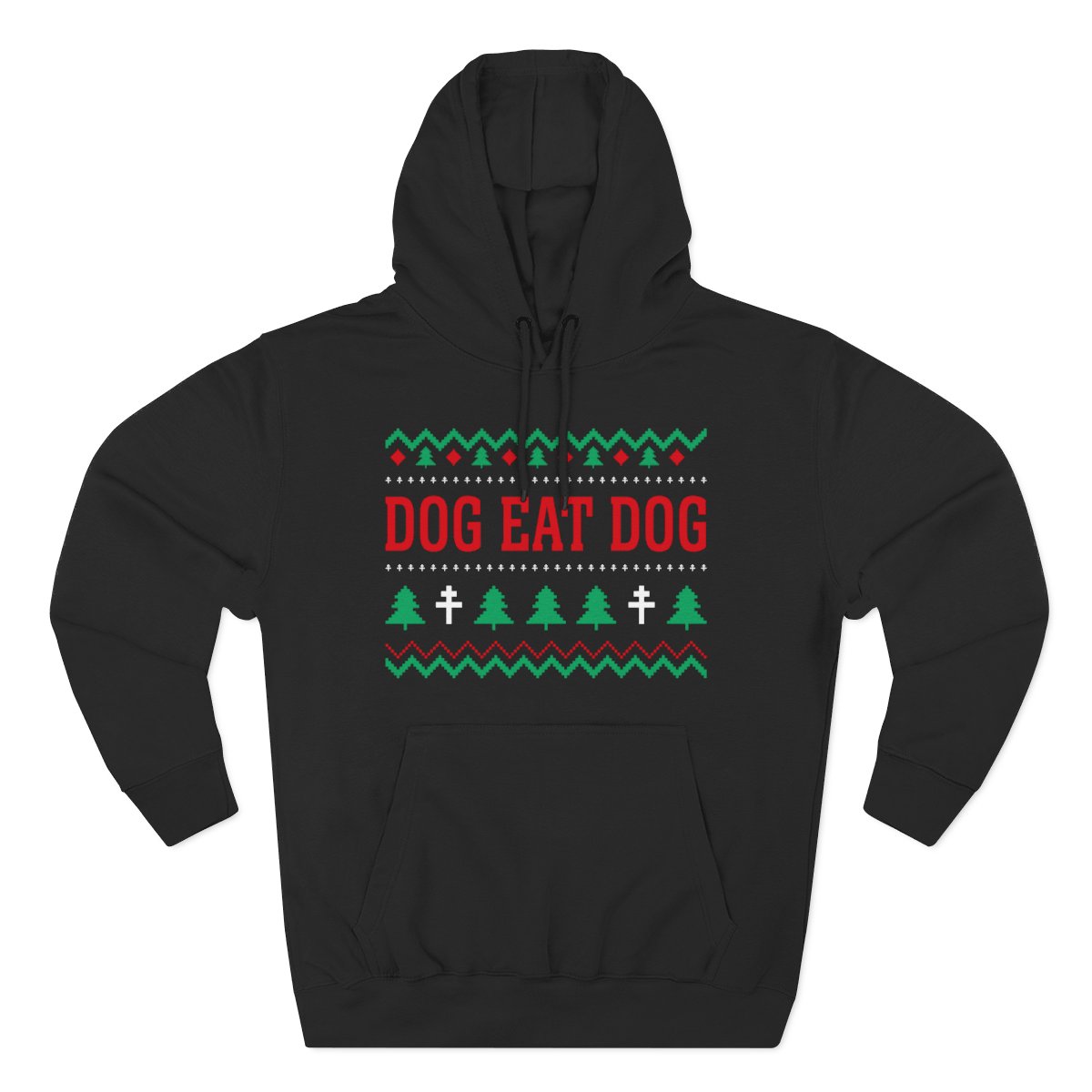
If pixel art is your thing, it sits nicely beside the Arigameplays Pixel Christmas Sweater hoodie here: both swap the usual knit for a blocky, game-style pattern of trees and red shapes. One for the gamer, one for the person who wore out a copy of Play Games, and the two look like a set under the tree.
For the cold mornings, the Christmas Knit three-panel fleece hoodie is the warmest way to wear it.
The takeaway
Dog Eat Dog started in a Jersey basement and built a sound out of hardcore, hip-hop, funk and a saxophone that still stands apart. Pick the side of that sound you love most, whether it's the snarl of Bleach USA, the crown of All Boro Any City or the pixel trees of Christmas Knit, and wear it the way the band plays: loud.